Global ESOP Taxation for Indian Professionals

Your ESOP value may look impressive on paper.
Your portfolio might tell a very different story.

For Indian professionals working at global tech companies, ESOPs are a meaningful part of compensation. They promise ownership, alignment, and long-term upside. Nevertheless, they are financial assets that come with a lot of considerations. To name a few, we have taxation, liquidity constraints, cross-border complexity, and concentration risk.

Understanding how ESOPs work from grant to dividend is essential if they are to build wealth rather than create stress.

What ESOPs Really Represent

An Employee Stock Option Plan (ESOP) gives you the right  (not the obligation) to purchase shares of your company at a pre-determined strike price, after a certain vesting period.

The lifecycle looks like this:

Taxation happens at two key stages – exercise and sale – and potentially every year if dividends are paid. If the company is listed outside India, cross-border rules add another layer.

Stage 1: Taxation at Exercise (India)

When you exercise your options and receive shares, the first taxable event occurs.

What is taxed?
The difference between:

Fair Market Value (FMV) on exercise date
minus
Exercise price

This difference is treated as perquisite income and taxed as salary.
Example:
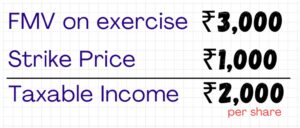
This amount is added to your salary and taxed at your slab rate (often 30% + surcharge + cess for senior professionals).

Why this matters

You may owe tax even though you have not sold the shares and received no cash.

If your employer deducts TDS, it will appear in Form 16. If not, you must pay advance tax yourself.

For many professionals, this is the first liquidity strain.

Stage 2: Taxation at Sale

When you sell the shares, capital gains tax applies.
Your cost of acquisition is the FMV on the exercise date, not the strike price.
If the shares are listed outside India (e.g., NASDAQ):

  • Held ≤ 24 months → Short-Term Capital Gains (STCG)
  • Held > 24 months → Long-Term Capital Gains (LTCG)

Tax Rates

  • STCG → Taxed at slab rate
  • LTCG → 20% with indexation

The US Layer: What Actually Happens

If you work for a global (say US-listed) company, US systems may still interact with your taxation.

As an Indian resident, your global income is taxable in India. However, US brokers may withhold tax unless proper documentation is in place.

At Exercise
If your employment services are rendered in India, India has primary taxing rights. US taxation at exercise is uncommon, though procedural withholding can occasionally occur.

At Sale
The US generally does not tax capital gains of non-residents on US-listed shares.
However, withholding may happen mechanically.
The critical step:

Ensure Form W-8BEN is filed with your broker.
This confirms you are a non-resident and eligible for India–US treaty benefits.
Without it, unnecessary US tax may be withheld.

What If US Tax Is Withheld?

If US tax is deducted, you have two options:

  1. Claim Foreign Tax Credit (FTC) in India

This is the most common and practical route.
You must:

  • Declare the income in India
  • Report US tax paid
  • File Form 67
  • Claim FTC

FTC reduces your Indian tax liability to the extent of US tax already paid.
You should not face double taxation.

  1. File a US Non-Resident Return (Form 1040-NR)

If a substantial amount was incorrectly withheld, you can file a US return and seek a refund from the IRS. This is typically worthwhile only for large amounts.

The principle is simple:

Treaty mechanisms exist between India and many countries to prevent double taxation (DTAA). It is important to stay informed and use them correctly.

Dividend Taxation: The Overlooked Third Layer

Once you exercise and hold shares, you are the same as any other shareholder. If the company pays dividends, another taxable event arises.

Step 1: US Withholding

US companies withhold tax on dividends paid to non-residents:

  • Default rate: 30%
  • India–US treaty rate: 25% (if W-8BEN is filed)

Step 2: Taxation in India

Foreign dividends are:

  • Taxable under “Income from Other Sources”
  • Fully taxed at your slab rate
  • Not eligible for concessional rates

Avoiding Double Tax

To avoid double taxation, you must:

  • Declare gross dividend income in India
  • Claim FTC for US tax withheld
  • Pay only the difference

Example (assuming 30% slab):
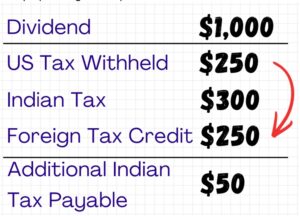
Total effective tax equals your slab rate – not double.

The Structural Risk: Concentration

Tax is only one part of the equation.
The bigger financial question is:
How much of your life is tied to one company?

  • Salary
  • Career trajectory
  • Unvested options
  • Exercised shares

All of these may depend on the same company.

ESOPs are equity exposure – often illiquid, volatile, and concentrated. They should fit within your asset allocation framework, not overwhelm it.

If a large portion of your net worth depends on your employer’s stock, your financial stability becomes correlated with your professional risk.

It is important to note that diversification is not pessimism. It is discipline.

Common Pitfalls to Avoid

Over time, several patterns repeat:

  • Exercising without planning for tax outflow
  • Ignoring liquidity timelines
  • Not filing W-8BEN
  • Failing to claim Foreign Tax Credit
  • Reporting net instead of gross dividend income
  • Allowing ESOPs to dominate overall net worth

Most mistakes stem from optimism without structure. Make sure you stay disciplined and avoid them.

Conclusion

ESOPs from global companies can be powerful wealth creators. But for an Indian resident, they come with a series of considerations.

When planned correctly, they accelerate wealth creation.
When ignored, they create avoidable tax friction and financial stress.

The difference lies in clarity.

At Vika Wealth, we help professionals integrate their ESOPs into their broader wealth plan to achieve financial freedom and long-term goals. Our approach focuses on aligning concentrated stock exposure with disciplined asset allocation and risk management.

Research Credits: Vishnu Mallipudi

Best Regards
Sri Subhash Yerneni,
Founder,
Vika Wealth.

Family Office | Estate Planning | Tax Services | ESOP Advisory | Company Incorporations | Mutual Funds | PMS | Bonds | AIF | Offshore Investing | Private Equity and Venture Capital Funds

Disclaimer: All the above views are for educational purposes and are not given as investment advice.

Subscribe To Our Blogs

About Author

Sri Subhash Yerneni

Sri Subhash is an astute banking and finance professional with 14 years of real-world experience in wealth management, advisory of financial instruments such as mutual funds-equity and debt-alternate investment funds ( AIF)-structure and offshore products-private equity-venture capital/debt-bonds and MLDs-priority banking-cash management-team management-and working with various cultures in various nations.

Scroll to Top