
Where REITs Fit in a Portfolio

Real estate is one of the largest asset classes in the world, especially in India. Yet many investors struggle to include it in their portfolios because direct property investment is expensive, illiquid, and difficult to diversify.

Real Estate Investment Trusts (REITs) solve this problem.

They allow investors to gain exposure to income-generating commercial real estate while maintaining liquidity and accessibility. In a portfolio context, they occupy an interesting middle ground between equities, fixed income, and real assets, making them a useful diversification tool.

When used strategically, REITs can add income, inflation protection, and diversification to a portfolio.

Why REITs Matter in Asset Allocation

A well-diversified portfolio is one that can sustain different market cycles, as it comprises of asset classes that contribute in different market conditions and offer different risk-reward characteristics. Lower correlation amongst the asset classes helps in diversification.
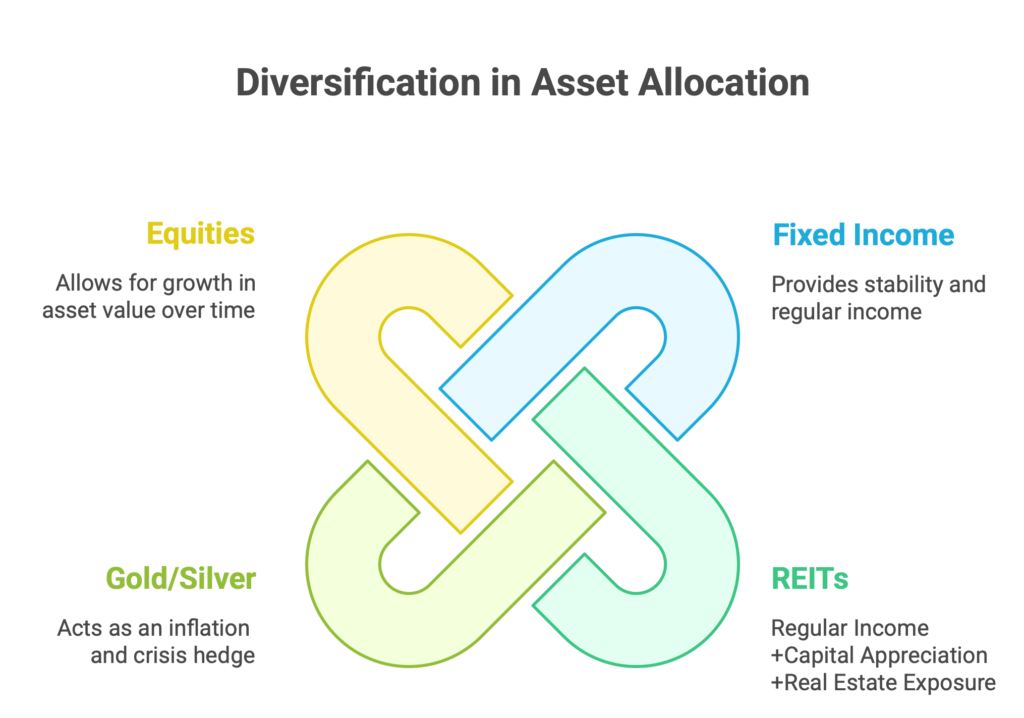
Key Benefits of REITs in a Portfolio

Diversification Benefits

Real estate return drivers are different from the drivers of the equity markets. Real estate is driven by rental growth, occupancy levels and property values. As a result, real estate and equities have historically shown low-to-moderate correlation. Adding REITs to your portfolio provides diversification benefits and improves risk-adjusted returns.

Stable Income Generation

REITs are primarily looked at as income vehicles. REITs are mandated to distribute a minimum of 90% of their net distributable cash flows. Cash flows come from long-term leases to high-quality tenants. Indian office REITs typically yield 6–8% distribution yield, making them comparable to fixed income instruments.

Inflation Hedge

Real estate has a natural relationship with inflation because:

  • Rental agreements often include annual escalation clauses
  • Replacement cost of real estate rises with inflation
  • Property values typically adjust upward over time

This makes REITs a partial hedge against inflation, something bonds struggle with.

Access to Institutional Quality Real Estate

Direct real estate investments, especially commercial real estate, has several barriers. These include large upfront capital requirements, illiquidity and concentration risk, making them inaccessible to most investors.

REITs allows investors to access:

  • Grade A commercial real estate
  • Diversified property portfolios (office and retail, across cities)
  • Professional management

Liquidity Compared to Physical Real Estate

Direct property investments are:

  • Illiquid
  • Difficult to rebalance
  • Have high transaction cost

REITs trade on stock exchanges, similar to stocks and ETFs, thereby providing liquidity and transparency.

Key Factors to Evaluate When Choosing a REIT

Not all REITs are created equal. The quality of the underlying assets, tenants, and financial structure can significantly impact long-term returns.

Here are some of the most important metrics and factors to evaluate.

Distribution Yield

The distribution yield is the annual cash distribution paid by the REIT relative to its market price. This is the closest equivalent to a bond yield or rental yield. Indian office REITs typically yield 6–8% distribution yield.

However, yield alone should not drive investment decisions.

Net Distributable Cash Flow (NDCF)

A REIT’s distributions are funded by NDCF – the cash generated from property operations after expenses, interest, and maintenance capex.

Investors should evaluate:

  • Growth in NDCF per unit
  • Stability of cash flows
  • Sustainability of distributions

Consistent growth in NDCF usually indicates healthy rental growth and strong asset performance.

Occupancy Rate

Occupancy is a key indicator of asset quality and demand. High-quality REITs usually maintain 85–95% occupancy levels.

Higher occupancy implies stable rental income and lower vacancy risk.

Persistent vacancy can signal location weakness or high tenant churn.

Weighted Average Lease Expiry (WALE)

WALE measures the average remaining lease duration of tenants.

A longer WALE indicates:

  • predictable rental income
  • lower tenant turnover risk

Institutional office REITs typically target 4–7 years of WALE.

Tenant Diversification and Quality

Tenant concentration is an important risk factor.

Investors should evaluate:

  • exposure to top tenant
  • sector diversification
  • credit quality of tenants

Many Indian office REIT tenants include global IT companies, consulting firms, and multinational corporations, which reduces default risk.

Growth Drivers in REITs

Acquisition Pipeline

Most REITs are sponsored by large real estate developers or institutional property owners. These sponsors typically maintain a pipeline of assets that can eventually be transferred to the REIT.

Evaluating the pipeline is important as it provides visibility of future growth, scale, diversification benefits and distribution growth.

Releasing Spread (Rental Growth)

Releasing spread measures the increase in rental rates when leases are renewed or new tenants replace existing ones.

Positive releasing spreads indicate strong demand for the property and rising rental markets.

Asset Upgrades and Value Creation

REITs can also increase rental income through active asset management:

  • Upgrading building infrastructure
  • Improving common amenities
  • Reconfiguring office layouts
  • Adding retail or service components

These upgrades make properties more attractive to tenants and allow the REIT to command higher rental rates when leases renew.

Understanding REIT Taxation

Distributions from REITs comprise of different types of income to the investor and taxation varies accordingly.

  1. Dividend Income

If the SPV opts for the concessional tax rate regime under Section 115BAA, dividend income is taxable for unitholders at applicable slab rates. If the SPV does not opt for the concessional tax rate regime, the dividend income is exempt for unitholders.

  1. Interest Income

Interest income earned is taxable as per the applicable slab rates.

  1. Capital Gains

Short-Term Capital Gains (STCG): Gains from selling REIT units held for less than one year are taxed at 20%.

Long-Term Capital Gains (LTCG): Gains from selling REIT units held for more than one year are taxed at 12.5% if they exceed ₹1.25 lakh annually. No indexation benefits.

  1. Rental Income

Rental income distributed is taxed at the applicable slab rates to the unitholder.

Conclusion

A well-constructed portfolio is not just about chasing returns – it is about strategically allocating across different assets that behave differently across market cycles.

REITs bring something unique to that mix: exposure to real assets, stable income, and the potential for growth over time.

Research Credits: Vishnu Mallipudi

Best Regards
Sri Subhash Yerneni,
Founder,
Vika Wealth.

Family Office | Estate Planning | Tax Services | ESOP Advisory | Company Incorporations | Mutual Funds | PMS | Bonds | AIF | Offshore Investing | Private Equity and Venture Capital Funds

Disclaimer: All the above views are for educational purposes and are not given as investment advice.

Subscribe To Our Blogs

About Author

Sri Subhash Yerneni

Sri Subhash is an astute banking and finance professional with 14 years of real-world experience in wealth management, advisory of financial instruments such as mutual funds-equity and debt-alternate investment funds ( AIF)-structure and offshore products-private equity-venture capital/debt-bonds and MLDs-priority banking-cash management-team management-and working with various cultures in various nations.

Scroll to Top