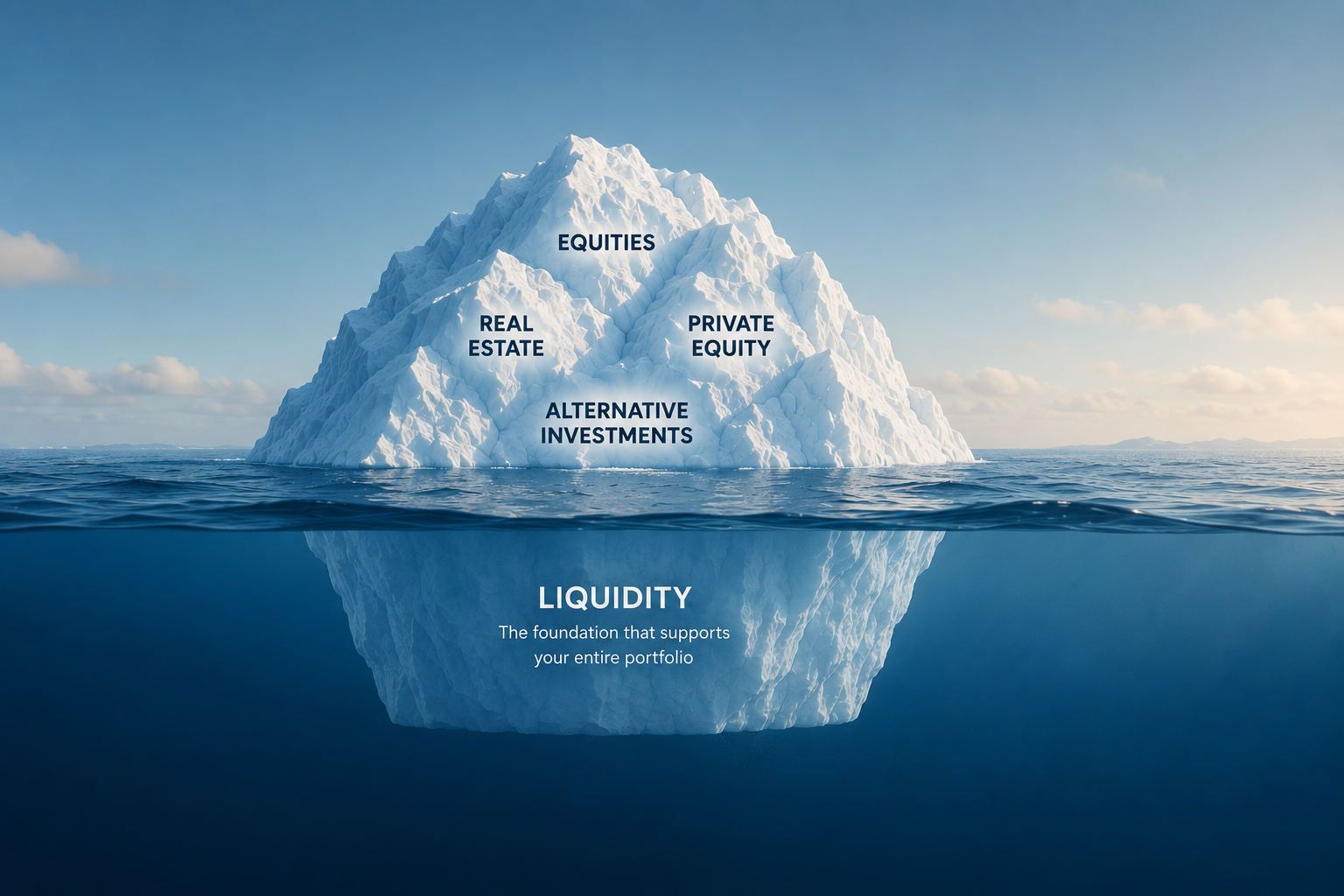
When investors evaluate an opportunity, they typically focus on two questions:
A third question often receives far less attention:
How quickly can I access my money if I need it?
The answer to that question is liquidity.
Liquidity refers to the ease with which an investment can be converted into cash without significantly affecting its value. While it may seem like a secondary consideration during periods of market optimism, liquidity often becomes most important during moments of uncertainty, personal emergencies, or when attractive opportunities emerge unexpectedly.
In many cases, liquidity is not just a convenience, it is a form of risk management.
Investors are frequently advised to “invest for the long term.” While this is sound advice, life rarely follows a perfectly predictable timeline.
The challenge arises when a significant portion of wealth is tied up in investments that cannot be easily accessed.
An investor may be wealthy on paper, yet unable to deploy capital when it matters most.
Different asset classes offer varying levels of liquidity.
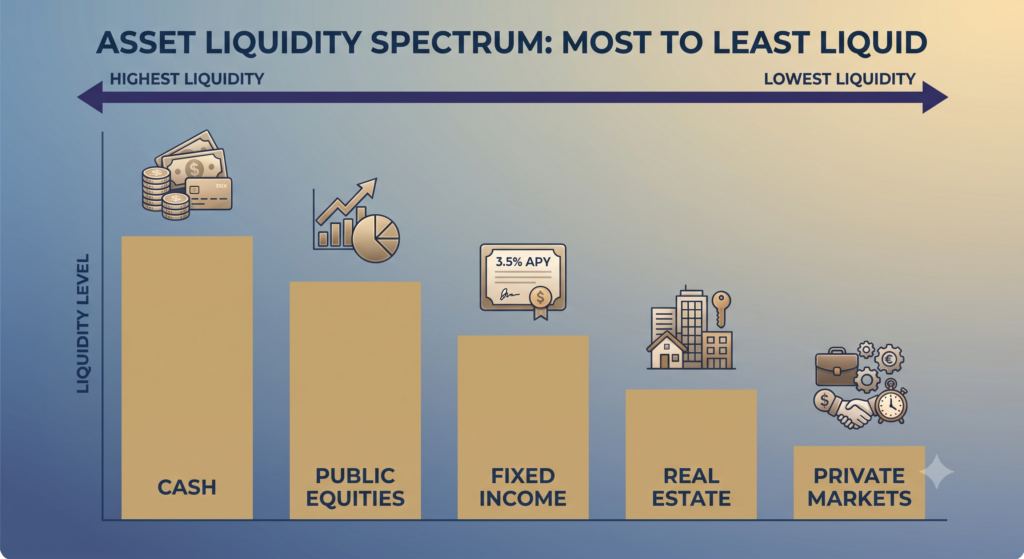
Cash and Liquid Funds
At one end of the spectrum are savings accounts, fixed deposits with short maturities, and liquid mutual funds.
These investments generally provide quick access to capital and serve as the first line of defense against unforeseen requirements.
Their drawback is lower long-term return potential.
Public Equities and Mutual Funds
Listed equities, ETFs, and open-ended mutual funds are generally considered highly liquid.
Investors can typically sell holdings and receive proceeds within a few days.
This combination of growth potential and liquidity is one reason publicly traded securities form the core of many investment portfolios.
However, market liquidity and price stability are not the same thing. While an investor can usually sell quickly, the price available during periods of market stress may be considerably lower than expected.
Bonds and Fixed Income Instruments
Government securities and high-quality bonds can provide varying levels of liquidity depending on the instrument and market conditions.
Some bonds trade actively, while others may be difficult to exit before maturity without accepting a discount.
Investors often assume all fixed-income investments are easily accessible, but liquidity can differ significantly across products.
Real Estate
Real estate is one of the most familiar examples of an illiquid asset.
Property transactions often require months to complete, involve substantial costs, and depend on market conditions.
During periods of economic weakness, sellers may face the difficult choice between waiting indefinitely or accepting a lower price.
While real estate can be an important wealth-building asset, it highlights why net worth and accessible capital are not the same thing.
Private Markets and Alternative Investments
Private equity, venture capital funds, pre-IPO opportunities, and certain structured investments often offer the potential for higher returns.
In exchange, investors typically commit capital for several years.
The liquidity sacrifice may be worthwhile for some investors, but only if it aligns with their broader financial plan.
The pursuit of higher returns should not come at the expense of financial flexibility.
Most discussions around liquidity focus on emergencies.
Equally important is the role liquidity plays in creating opportunities.
Market dislocations, business acquisitions, attractive investment opportunities, or strategic asset purchases often emerge when others are constrained.
Investors with available capital can act quickly and decisively.
Those whose wealth is locked away may be forced to watch from the sidelines.
Liquidity is therefore not only protection against downside risks; it is also a tool that enables future growth.
Holding excessive cash can be detrimental to long-term wealth creation.
At the same time, maximizing returns by allocating heavily to illiquid assets can create vulnerabilities.
The objective is not to make every investment liquid.
The objective is to ensure that the overall portfolio provides sufficient flexibility to meet foreseeable needs while still allowing long-term capital to compound effectively.
A well-constructed portfolio recognizes that different pools of capital serve different purposes.
Some assets provide growth; Some provide income; Some provide diversification.
And some provide liquidity.
Each plays a distinct role.
Investors often spend considerable time analyzing expected returns, valuations, and market forecasts.
Liquidity deserves equal attention.
Because when circumstances change, opportunities arise, or markets become uncertain, the most valuable asset may not be the one with the highest return potential.
It may simply be the one you can access when you need it.
Family Office | Estate Planning | Tax Services | ESOP Advisory | Company Incorporations | Mutual Funds | PMS | Bonds | AIF | Offshore Investing | Private Equity and Venture Capital Funds
Disclaimer: All the above views are for educational purposes and are not given as investment advice.

Sri Subhash is an astute banking and finance professional with 14 years of real-world experience in wealth management, advisory of financial instruments such as mutual funds-equity and debt-alternate investment funds ( AIF)-structure and offshore products-private equity-venture capital/debt-bonds and MLDs-priority banking-cash management-team management-and working with various cultures in various nations.
AMFI-registered Mutual Fund Distributor – ARN 257866
AMFI-registered SIF Distributor – ARN 257866
APMI PMS Distributor – APRN00458
3rd Floor, Plot No. 55/A, Rd No 52, BNR Hills, Jubilee Hills, Rai Durg, Hyderabad - 500081
Copyright © 2025 VIKA WEALTH – All Rights Reserved.
AMFI-registered Mutual Fund Distributor – ARN 257866
AMFI-registered SIF Distributor – ARN 257866
APMI PMS Distributor – APRN00458
3rd Floor, Plot No. 55/A, Rd No 52, BNR Hills, Jubilee Hills, Rai Durg, Hyderabad - 500081
Copyright © 2025 VIKA WEALTH – All Rights Reserved.