
China’s Investment Case: Why Investors Should Pay Attention Again

When we wrote about the economic and market landscape in China early last year, the country was grappling with weak sentiment, concerns around the property sector, and an uncertain economic outlook. Since then, the investment landscape has evolved considerably. In this article, we revisit China and examine why the case for global investors may be becoming increasingly compelling.

Investors typically prefer investing in markets they understand, as they feel familiar and easier to follow. This ‘Home Bias’ is one of the most common tendencies among investors. However, limiting investments to a single country can expose a portfolio to concentrated economic and market risks.

Different economies move through different business cycles, respond differently to policy changes, and offer varying growth opportunities. This is why geographic diversification plays an indispensable role in long-term investing.

Over the past 3 decades, emerging markets have gained considerable investment interest due to their stronger economic growth prospects and outperformance. MSCI’s emerging markets classification identifies 24 economies with such prospects, including notable names such as India, China, Indonesia, Taiwan, and Korea.

Among the emerging markets, China continues to occupy a unique position. As the world’s second-largest economy, it continues to be deeply integrated into global manufacturing, technology, and trade. Recent macroeconomic developments suggest that the Chinese equity market deserves a fresh look.

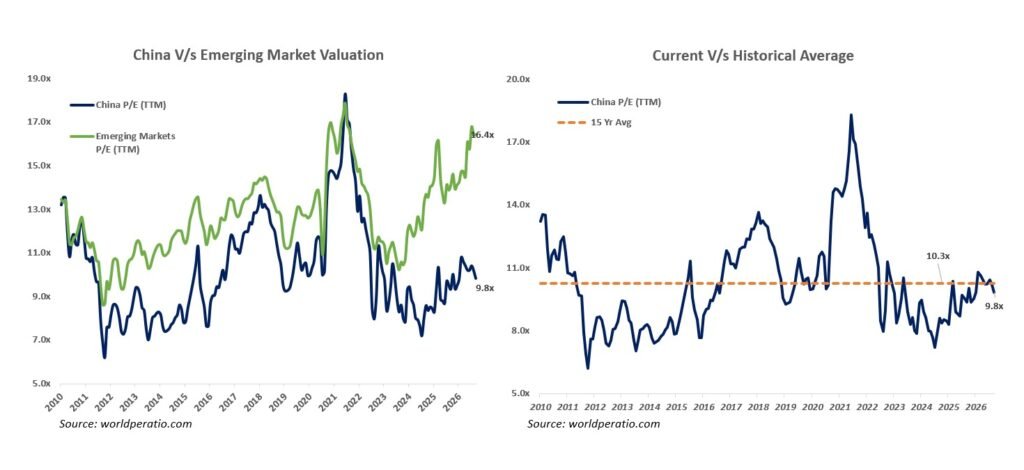
China continues to trade below its long-term historical PE as well as relative to emerging markets’ PE. This provides an attractive entry point in terms of valuation for investors.
Why China, Why Now?

China has remained out of favour with global investors over the past few years due to concerns surrounding the property sector, regulatory changes, geopolitical tensions, and slower economic growth. As a result, investor sentiment remains cautious despite meaningful policy support and improving macroeconomic indicators.

Historically, some of the strongest long-term investment opportunities have emerged when valuations were depressed and investor expectations were low. Today, Chinese equities continue to trade below their long-term historical valuations and at a discount to several other emerging markets. As economic activity gradually stabilises, domestic consumption strengthens, and policy support continues, investors have an opportunity to participate in a market where much of the pessimism already appears to be reflected in prices.

The Macro View

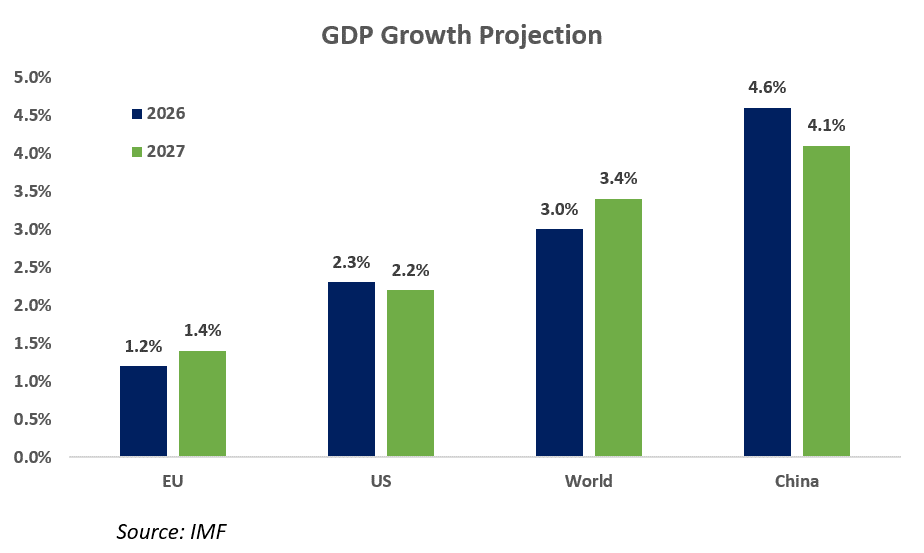
China’s economic growth is expected to remain resilient, with the OECD forecasting GDP growth of 4.5% in 2026 and 4.3% in 2027. Although this is lower than the rapid growth rates seen in previous decades, it remains strong compared to many large economies.
The Chinese government is increasingly shifting towards strengthening domestic consumption. Recent policy initiatives include greater support for elderly and low-income households through targeted subsidies, with the objective of improving household spending and creating a more balanced economic model. This transition could provide a more sustainable foundation for long-term growth.

China’s monetary policy also remains supportive. Interest rates continue to stay accommodative, and no significant rate hikes are expected in the near future. A stable interest rate environment helps maintain liquidity in the financial system while supporting investment and economic activity.

Another notable observation has been the resilience of the Renminbi (RMB). During the recent US-Iran conflict, it was the only major Asian currency to appreciate against the US Dollar, reflecting relative stability amid heightened geopolitical uncertainty.

Despite ongoing geopolitical tensions and energy market disruptions, industrial production has remained robust through the first quarter of FY 2026. This reflects the resilience of China’s manufacturing base, which continues to play a central role in both domestic growth and global supply chains.
Foreign Investor Positioning

Despite signs of improving economic stability, global investor participation in Chinese equities remains well below historical levels. Years of cautious sentiment have resulted in relatively low foreign ownership compared to previous market cycles.

This presents an interesting opportunity. When economic data continues to improve and policy measures translate into stronger corporate earnings, even a gradual return of foreign institutional capital could provide an additional tailwind for equity markets. While predicting capital flows is difficult, low investor positioning often creates favourable conditions for long-term investors when fundamentals begin to improve.

Where Will the Earnings Growth Come From?

While China’s headline GDP growth has moderated from the double-digit levels witnessed in previous decades, the composition of growth is undergoing a structural transformation. Rather than relying predominantly on infrastructure and real estate, the economy is increasingly being driven by innovation, technology, advanced manufacturing, and domestic consumption.

Government support for Artificial Intelligence (AI), semiconductors, electric vehicles (EVs), robotics, digital infrastructure, biotechnology, and renewable energy continues to encourage investment across high-growth sectors. At the same time, policy measures aimed at boosting household consumption are expected to benefit consumer-focused businesses, internet platforms, travel, healthcare, and premium consumption.

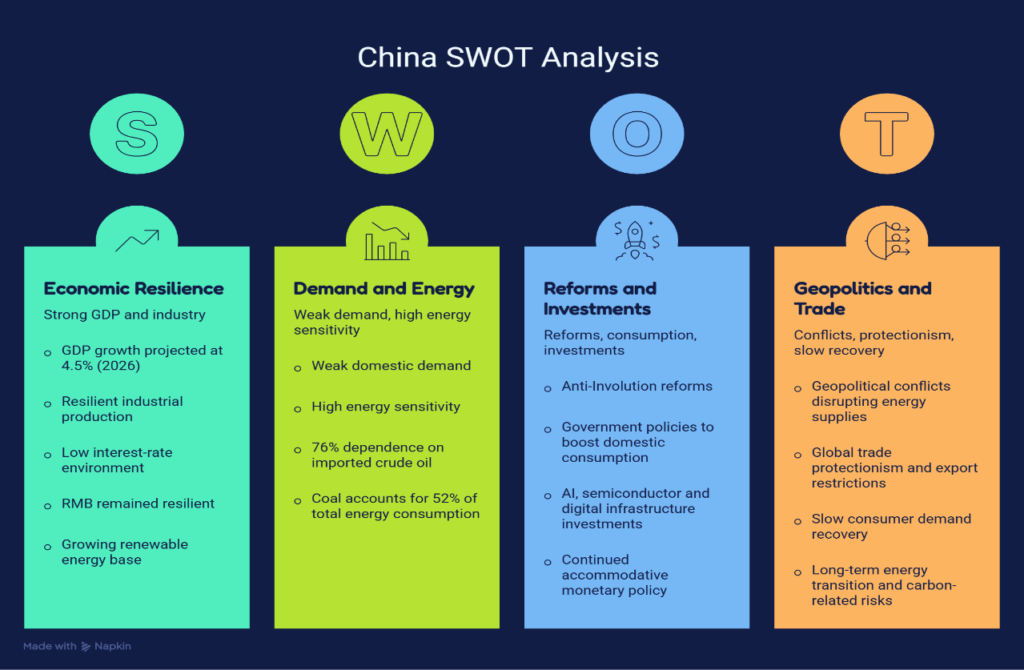
The recently announced “Anti-Involution” campaign also aims to reduce excessive price competition and industrial overcapacity, allowing healthier profit margins across several industries. Together, these structural changes have the potential to support sustainable corporate earnings growth over the coming years.

Understanding the Risks

No investment opportunity is without risks, and China continues to face structural and cyclical challenges. Weak domestic demand, a prolonged recovery in the property sector, demographic headwinds, and deflationary pressures remain areas that investors should monitor closely.

Geopolitical tensions, particularly between China and the United States, including tariffs, trade restrictions, technology export controls, and developments surrounding Taiwan, could continue to influence investor sentiment and market volatility. Currency movements and changes in government regulations may also impact returns for international investors.

Energy security remains another structural consideration. Coal continues to account for nearly 52% of China’s energy consumption, while renewable energy contributes approximately 18.3%. Additionally, around 76% of China’s crude oil requirements are met through imports, making the economy sensitive to global energy prices. However, compared to several other regional economies, China’s relatively diversified energy mix and strong manufacturing base provide a degree of resilience.

While these risks should not be overlooked, they also explain why valuations remain attractive. For long-term investors, balancing these risks against improving fundamentals and supportive policy measures is essential when evaluating the opportunity.

Why Should Indian Investors Consider China?

Indian investors have historically demonstrated a strong home-country bias, with the majority of their equity exposure concentrated within domestic markets. While India remains one of the most compelling long-term growth stories globally, relying solely on a single market can increase portfolio concentration risk.

International diversification allows investors to participate in different economic cycles, policy environments, and industry leaders across global markets. China provides exposure to sectors where it enjoys global leadership, including advanced manufacturing, electric vehicles, batteries, industrial automation, internet platforms, and artificial intelligence. These businesses complement, rather than compete with, many of the sectors that dominate Indian equity markets.

A well-diversified portfolio does not require choosing between India and China. Instead, selective exposure to both economies can help improve long-term risk-adjusted returns while reducing dependence on the performance of any single market.

Family Office | Estate Planning | Tax Services | ESOP Advisory | Company Incorporations | Mutual Funds | PMS | Bonds | AIF | Offshore Investing | Private Equity and Venture Capital Funds

Disclaimer: All the above views are for educational purposes and are not given as investment advice.

If our approach resonates with you, let’s discuss how your portfolio aligns with your long-term goals

About Author

Sri Subhash Yerneni

Sri Subhash is an astute banking and finance professional with 14 years of real-world experience in wealth management, advisory of financial instruments such as mutual funds-equity and debt-alternate investment funds ( AIF)-structure and offshore products-private equity-venture capital/debt-bonds and MLDs-priority banking-cash management-team management-and working with various cultures in various nations.

AMFI-registered Mutual Fund Distributor – ARN 257866
AMFI-registered SIF Distributor – ARN 257866
APMI PMS Distributor – APRN00458

Contact Info

3rd Floor, Plot No. 55/A, Rd No 52, BNR Hills, Jubilee Hills, Rai Durg, Hyderabad - 500081

Copyright © 2025 VIKA WEALTH – All Rights Reserved.

Scroll to Top