GST Reforms 2025: Simplifying Taxes, Boosting Growth

India has launched its most significant tax reform since 2017 with GST 2.0, coming into effect on September 22, 2025.

This comprehensive overhaul simplifies the country’s complex tax structure while strategically boosting consumer spending to drive economic growth. The government’s approach is clear: reduce taxes on everyday items to increase purchasing power, which will stimulate business activity and accelerate GDP growth across all sectors.

The Economic Logic Behind GST 2.0

India needed this reform because its original GST system had become overly complicated. The four-tier structure (5%, 12%, 18%, 28%) created business disputes, compliance burdens, and economic inefficiencies that slowed growth. Many industries faced “inverted duty structures” where they paid higher taxes on raw materials than on finished products, creating cash flow problems.

GST 2.0 consolidates the existing four-slab system into a simplified two-tier structure: 5% and 18% for most goods, with a special 40% rate for luxury and sin goods.

Essential daily-use items move to the 5% bracket, including food products, toiletries, household goods, and agricultural equipment. Consumer durables and automobiles shift to 18%, while luxury cars, tobacco, and alcohol face the new 40% rate.

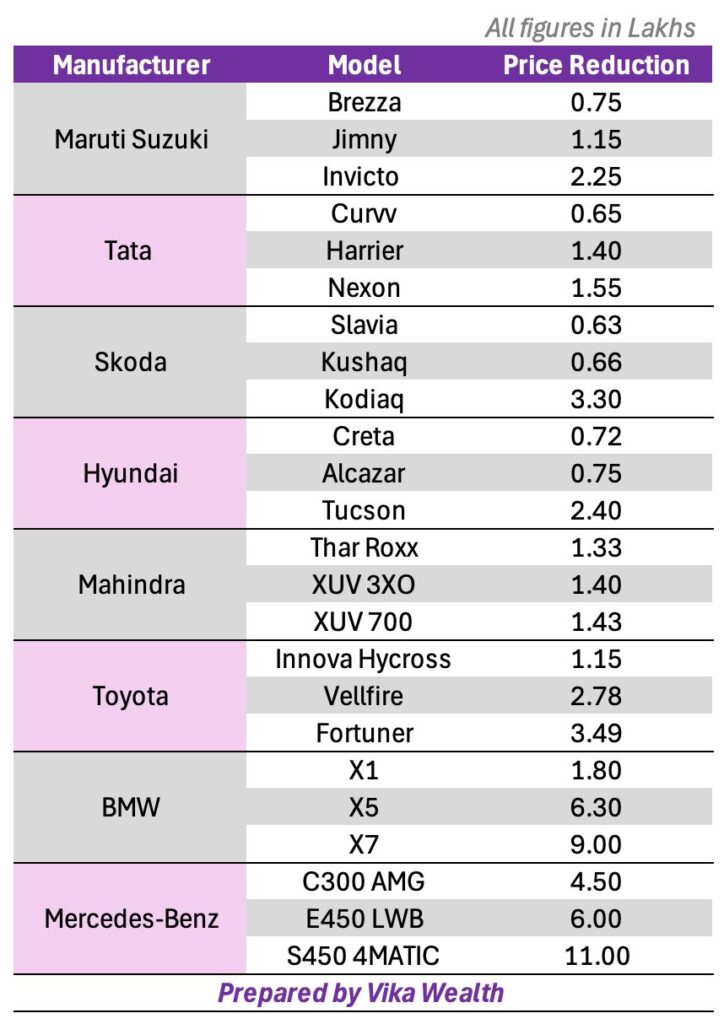
Car Price Reductions Announced by Manufacturers
Consumption Impact: The Economic Chain Reaction

The government will lose an estimated amount of ₹48,000 crore annually from reduced tax rates, but this is expected to generate ₹1.98 lakh crore in additional consumer spending – a 4:1 return on fiscal investment (₹1 of tax cut leads to ₹4 of additional economic activity).

This spending creates more business for companies, who then hire additional workers and purchase more inputs. These new employees also spend their salaries, creating successive rounds of economic activity that amplify the original tax benefit.

Research shows GST cuts work better than income tax reductions. For every rupee the government loses from GST reduction, the economy gains ₹1.08. Income tax cuts only generate ₹1.01 for each rupee lost. This makes GST reform the more efficient policy tool for boosting economic growth.

Growth Mechanism

GST 2.0’s GDP impact operates through multiple interconnected channels. The primary channel is direct consumption increase, where reduced prices immediately boost purchasing power for 140 crore Indians. This consumption increase directly adds to GDP since private consumption represents 60% of India’s economic output.

Economic experts predict GST 2.0 will add 100-120 basis points to GDP growth over the next 4-6 quarters. Combined with earlier income tax cuts worth ₹1 lakh crore, total consumption stimulus reaches ₹5.31 lakh crore, equivalent to 1.6% of India’s entire GDP.

The secondary channel involves business investment and employment generation. As consumption increases, companies expand production capacity, hire more workers, and invest in new facilities.

Festive Season Amplification

Coming into effect on September 22, the timing strategically positions GST 2.0 at the start of India’s biggest shopping season. The festive period from Navratri to Diwali to the wedding season accounts for 30-40% of annual sales in many categories.

This timing creates natural demand amplification as price reductions coincide with seasonal spending increases. Indians traditionally buy cars, electronics, appliances, jewellery, and clothing during festivals, exactly the categories receiving major tax cuts. Total festive spending reaches ₹1.85 lakh crores annually, making this timing crucial for maximizing economic impact.

Revenue Strategy: Short-term Investment for Long-term Gain

The immediate ₹48,000 crore annual revenue reduction represents a strategic investment in economic growth rather than permanent revenue loss.

The recovery mechanism works because GST is levied on transaction values. Higher consumption volumes at lower rates often generate more total tax than lower volumes at higher rates. Government analysis projects ₹52,000 crore additional GST revenue in FY26 from increased economic activity, making the reform revenue-positive within 2-3 years.

Technology Integration and Business Efficiency

GST 2.0 includes major technology upgrades that enhance both compliance ease and economic efficiency. The simplified rate structure reduces classification complexities that previously required manual intervention and created business delays.

The reform makes it simpler for small businesses to pay taxes legally. Because of this, more businesses will come under the tax system (wider tax base). Once they are in the formal system, they can also get easier access to bank loans and funding, which helps them grow.

Key Sectoral Impact

  • Automobile: Small cars and two-wheelers see their GST rate cut from 28% to 18%, making vehicles more affordable and boosting expected sales volumes.
  • FMCG (Fast-Moving Consumer Goods): Everyday products such as biscuits, chocolates, soaps, and shampoos move from 18% (or 12%) to 5% GST, encouraging higher consumption.
  • Cement: GST on cement falls from 28% to 18%, reducing the price of a 50 kg bag by about ₹25–30, which should spur construction activity and volume growth.
  • Consumer Durables: White-goods items like air conditioners, televisions, and washing machines drop from 28% to 18% GST ahead of the festive season, lifting demand for brands in this category.
  • Insurance: Life and health insurance premiums become fully GST-exempt (previously taxed at 18%), lowering costs for policyholders while requiring insurers to adjust pricing due to the loss of input tax credits.
  • Textiles & Apparel: Under the new GST rules, ready-made garments priced up to ₹2,500 will be taxed at 5%, while those priced above ₹2,500 will now face an 18% rate instead of the earlier 12%.

Conclusion

GST 2.0 marks a pivotal step in India’s ongoing economic transformation by streamlining the tax structure and targeting relief towards essential goods. With its strategic timing ahead of the festive season, the reform is set to boost consumption, stimulate business investments, and accelerate job creation.

Despite the expected stimulus, we must note that markets will not just move based on the tax cuts, the underlying fundamentals, valuations and macro factors still weigh in on the market movements.

Research Credits: Unnati Somani

Best Regards
Sri Subhash Yerneni,
Founder,
Vika Wealth.

Family Office | Estate Planning | Tax Services | ESOP Advisory | Company Incorporations | Mutual Funds | PMS | Bonds | AIF | Offshore Investing | Private Equity and Venture Capital Funds

Disclaimer: All the above views are for educational purposes and are not given as investment advice.

Subscribe To Our Blogs

About Author

Sri Subhash Yerneni

Sri Subhash is an astute banking and finance professional with 14 years of real-world experience in wealth management, advisory of financial instruments such as mutual funds-equity and debt-alternate investment funds ( AIF)-structure and offshore products-private equity-venture capital/debt-bonds and MLDs-priority banking-cash management-team management-and working with various cultures in various nations.

Scroll to Top