India's Green Energy Surge: Why Renewables Are the Investment Story of the Decade

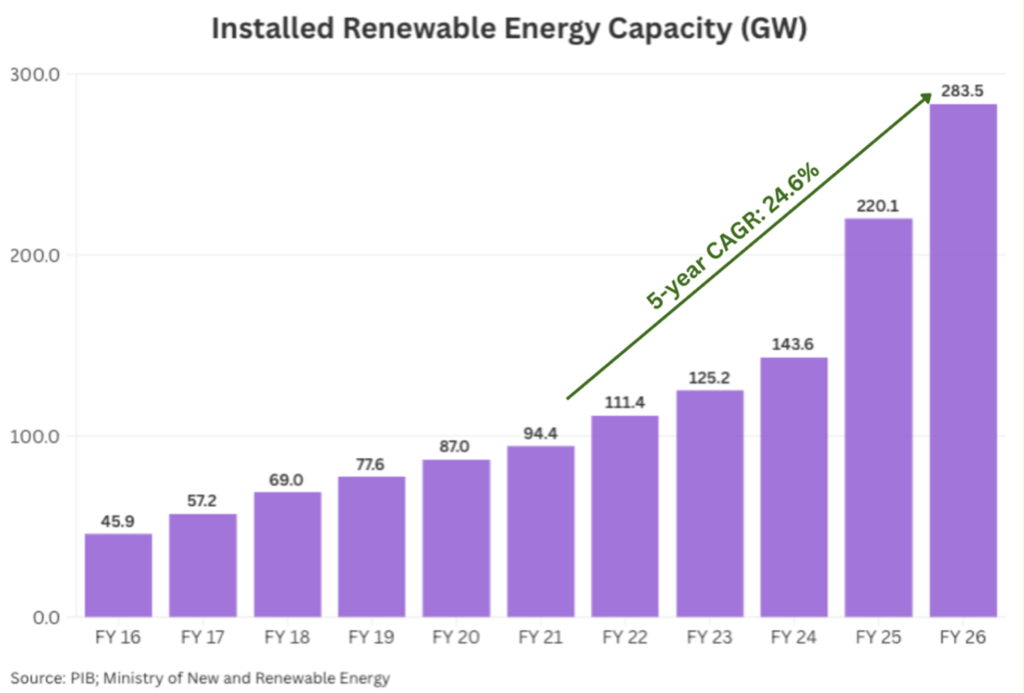
There’s a number that tells you everything you need to know about India’s energy story: 55.3 GW. That’s how much renewable energy capacity India added in FY 2025-26. To put it in perspective, that’s roughly the entire installed power capacity of a mid-sized European country, built in a year.

 India’s total installed capacity from non-fossil fuel sources stands at 284 GW, which ranks us third globally.
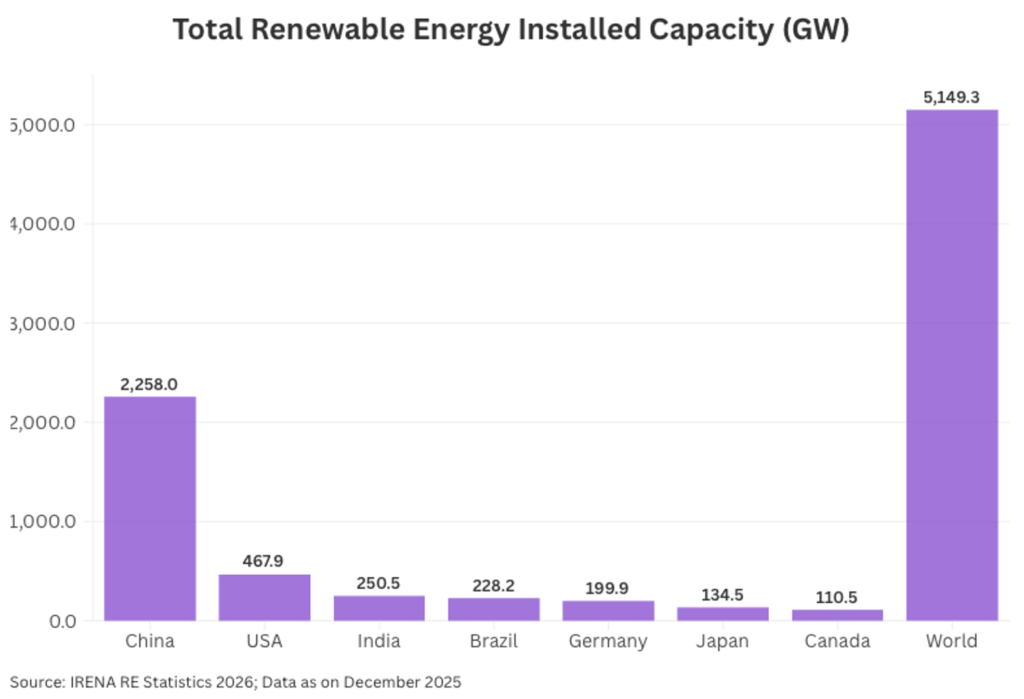
India is not incrementally expanding its clean energy footprint. It is undergoing a structural transformation. For investors, the window to participate is wide open.

The Demand Case Is Undeniable

India will drive 35% of global energy demand growth over the next two decades. A young, urbanising population, an explosion in air conditioning and EV ownership, rising industrial output, and a data centre build-out targeting 8 GW by 2030 – all of this is creating a huge demand for electricity. The Central Electricity Authority projects peak power demand could exceed 1,000 GW by 2035-36.

Renewables are not being adopted out of environmental idealism. They are now simply the cheapest source of new power generation. Solar tariffs in India have fallen 90% over a decade — to around ₹2/kWh — making them 35–50% cheaper than new coal. When economics and policy align this cleanly, investment follows at scale.

A Government That Has Put Its Money Where Its Mouth Is

India’s Panchamrit commitments at COP26 set an ambitious target: 500 GW of non-fossil fuel capacity by 2030, net zero by 2070. What’s remarkable is that India already hit the interim milestone – 50% of installed electricity capacity from non-fossil sources – in June 2025.

This hasn’t happened by accident. The policy scaffolding is comprehensive and well-funded. The MNRE budget for FY26 was increased 39% year-on-year to $3 billion. The Production Linked Incentive (PLI) scheme for solar manufacturing has catalysed 144 GW per annum of domestic module manufacturing capacity, up nearly 100% in 2025 alone. GST on solar modules and wind turbines was cut from 12% to 5%. The Green Energy Corridor is channelling ₹12,000 crore into transmission infrastructure. Viability Gap Funding is being deployed for battery storage and offshore wind.

The government has, in effect, de-risked the investment case across the value chain – from manufacturing to generation to grid.

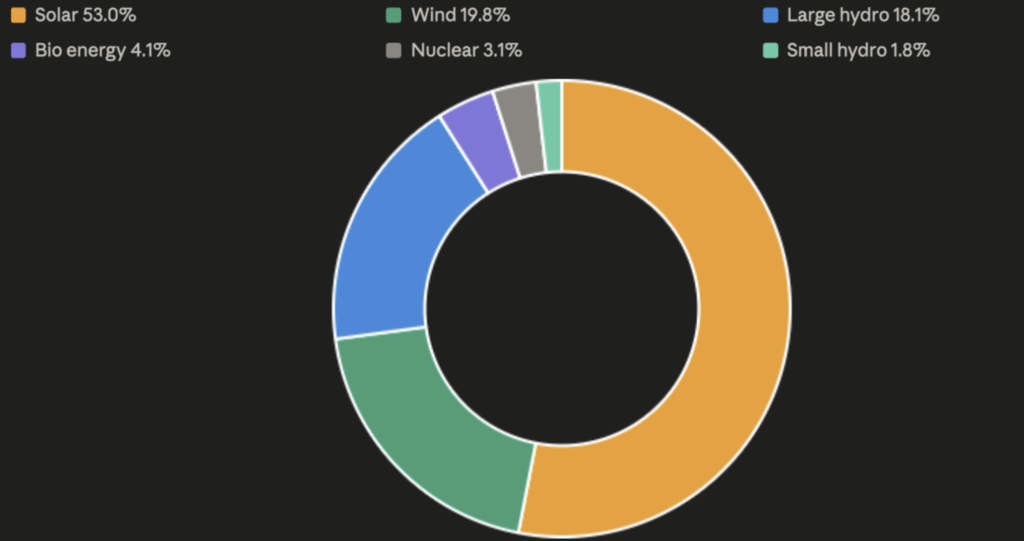
So far, a total of 283.46 GW of capacity from non-fossil fuel sources has been installed in the country as on FY 2025-26 end. This includes 150.26 GW Solar Power, 56.09 GW Wind Power, 11.75 GW Bio Energy, 5.17 GW Small Hydro Power, 51.41 GW Large Hydro Power and 8.78 GW Nuclear Power capacity.
The Opportunity Set Is Broad

The sector isn’t a single trade. There are at least five distinct investment angles:

Solar generation and IPPs remain the core. India added 30+ GW of solar in just the first nine months of FY26 – surpassing FY25’s full-year addition. With a pipeline of 142 GW of projects and SECI issuing tenders at 50 GW per annum, the volume of bankable, PPA-backed projects is unprecedented. India is currently the world’s third largest solar producer.

Domestic solar manufacturing is a structurally protected business. The ALMM framework (Approved List of Models and Manufacturers) effectively creates an import barrier that rewards Indian producers. Module prices in India are nearly double imported prices precisely because of this protection – a significant margin enabler for compliant manufacturers.

Wind energy is at an inflection point. FY 2025-26 saw the highest-ever annual addition to wind capacity, 6.05 GW of onshore wind. India has a 100 GW target by 2030 – implying a near-doubling from current levels. Offshore wind, though nascent with zero operational capacity today, has 37 GW of auctions planned through 2030, backed by VGF support.

Energy storage (BESS) is arguably the most underpenetrated and urgent opportunity. India currently has just ~6 GW of storage against a 2030 requirement of 51–61 GW. The government has already approved ₹5,400 crore in VGF for 30 GWh of BESS deployment. New solar tenders now mandate a minimum 2-hour storage component – creating a captive, policy-driven demand signal.

Grid infrastructure – transformers, transmission cables, smart meters – is the picks-and-shovels play. India has announced a ₹9.2 lakh crore plan to upgrade its power grid. Distribution transformers sanctioned under the Revamped Distribution Sector Scheme are running at just 25% installation versus sanction, pointing to a massive supply gap.

The Risks Are Real, But Manageable

No honest investment thesis ignores the headwinds. DISCOM unpaid dues stood at over $9 billion as of March 2025 – off-taker risk remains the sector’s most persistent structural weakness. Grid curtailment in high-renewable states like Rajasthan and Tamil Nadu hit 10–30% in 2025 due to transmission bottlenecks. China’s tightened export controls on critical minerals add supply chain uncertainty for wind and storage.

These are genuine risks. But they are execution risks in a sector with visible, multi-year government-mandated demand. As a result, these risks are not seen as existential ones.

The Bottom Line

India’s renewable energy transition is past the point of being a bet on future policy. It is a present-tense industrial reality, backed by $23 billion in FDI since 2020, record capacity additions, and a manufacturing ecosystem that is scaling rapidly.

The question for investors is no longer whether India’s energy transition will happen. It’s whether you’re positioned for it.

Research Credits: Vishnu Mallipudi

Best Regards
Sri Subhash Yerneni,
Founder,
Vika Wealth.

Family Office | Estate Planning | Tax Services | ESOP Advisory | Company Incorporations | Mutual Funds | PMS | Bonds | AIF | Offshore Investing | Private Equity and Venture Capital Funds

Disclaimer: All the above views are for educational purposes and are not given as investment advice.

Subscribe To Our Blogs

About Author

Sri Subhash Yerneni

Sri Subhash is an astute banking and finance professional with 14 years of real-world experience in wealth management, advisory of financial instruments such as mutual funds-equity and debt-alternate investment funds ( AIF)-structure and offshore products-private equity-venture capital/debt-bonds and MLDs-priority banking-cash management-team management-and working with various cultures in various nations.

Scroll to Top