
Global Equity and Domestic Equity: Why a Portfolio Needs Both

Over the last decade, US equities (particularly large tech companies) have delivered exceptional returns. As a result, many investors today are looking beyond India and asking whether they should increase their allocation to international markets.

While the question is valid, the reasoning often isn’t.

Too often, international investing is viewed through the lens of recent performance. Investors see the strong returns generated by US markets and conclude that international equity is the key to generating higher returns. But this misses the true purpose of global investing.
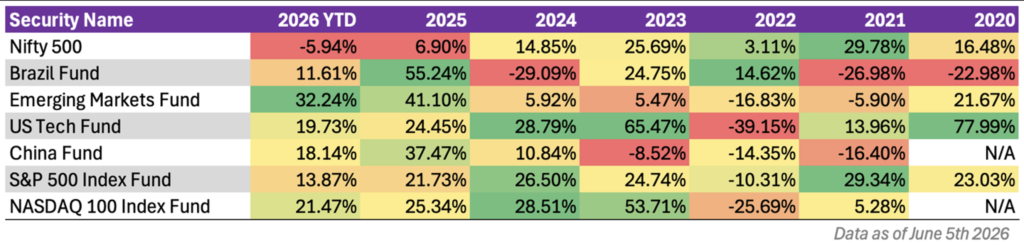
International equity is not primarily a return-enhancement tool. It is a diversification tool.

Beyond Performance Chasing

Successful portfolio construction is not about identifying the market that performed best over the last decade. It is about building a portfolio that can navigate different economic and market environments over the next decade.

For Indian investors, domestic equity remains the foundation of long-term wealth creation. It provides exposure to India’s growth story, supported by favourable demographics, rising incomes, infrastructure development, and increasing formalisation of the economy.

However, concentrating an entire portfolio in a single country also creates concentration risk.

International equity helps address this by providing exposure to different economies, different currencies, and different market drivers. Rather than replacing domestic equity, it complements it.

The objective is not to choose between India and the world. It is to avoid being overly dependent on either.

Access to Different Sources of Return

One of the most valuable benefits of international investing is exposure to return drivers that may differ from those influencing Indian markets.

Different economies go through different cycles. Economic growth, interest rate movements, regulatory changes, and consumer trends often vary significantly across countries. As a result, global markets do not always move in sync with India.

This creates the potential for more diversified and less correlated sources of return.
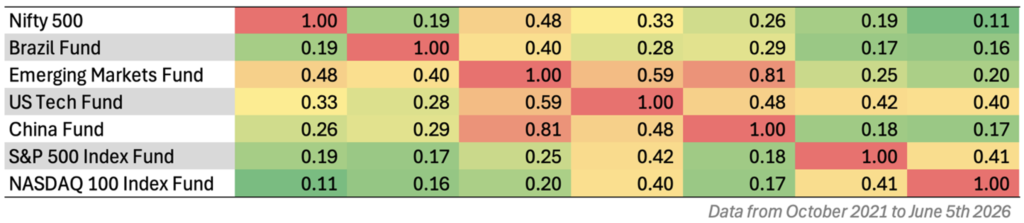
There will be periods when Indian equities outperform global markets and periods when the reverse is true. Attempting to predict these cycles consistently is difficult. By maintaining exposure to both domestic and international equities, investors reduce their reliance on a single market being the primary driver of portfolio returns.

Diversification may not always improve returns, but it can improve the consistency and resilience of outcomes.

Exposure to Opportunities Beyond India

International investing also provides access to sectors and businesses that are difficult to access through Indian listed markets.

Many of the world’s leading companies operate in industries such as semiconductors, advanced software, artificial intelligence infrastructure, biotechnology, and global consumer brands. These sectors either have limited representation or are largely absent in India.

Global equity allows investors to participate in these opportunities while continuing to benefit from India’s long-term growth story.

The Importance of a Staggered Approach

Successful portfolio construction is not about identifying the market that performed best over the last decade. It is about building a portfolio that can navigate different economic and market environments over the next decade.

For Indian investors, domestic equity remains the foundation of long-term wealth creation. It provides exposure to India’s growth story, supported by favourable demographics, rising incomes, infrastructure development, and increasing formalisation of the economy.

However, concentrating an entire portfolio in a single country also creates concentration risk.

International equity helps address this by providing exposure to different economies, different currencies, and different market drivers. Rather than replacing domestic equity, it complements it.

The objective is not to choose between India and the world. It is to avoid being overly dependent on either.

Why Valuations Matter

The case for international diversification is strong. However, the timing of investor interest often deserves scrutiny.

Most investors become interested in an asset after it has already delivered strong returns. Unfortunately, periods of exceptional performance are often accompanied by elevated valuations and optimistic expectations.

A great business does not automatically make a great investment.

The price paid for it matters.

When valuations become stretched, future returns can be lower than investors expect, even if the underlying companies continue to perform well. This is why portfolio decisions should not be driven solely by past performance.

The role of international equity in a portfolio remains important regardless of which market has recently outperformed. However, the pace and manner of investing should take valuations into account.

The Importance of a Staggered Approach

When valuations appear elevated, investors may benefit from building exposure gradually rather than making large lump-sum allocations.

A staggered investment approach helps reduce the risk of deploying significant capital at a point when expectations are particularly high. It also shifts the focus away from short-term market movements and towards long-term portfolio construction.

The goal is not to predict the perfect entry point. It is to gain exposure in a disciplined manner while acknowledging that valuation matters.

The Bottom Line

The decision to invest internationally should not be driven by the recent success of US technology stocks or the fear of missing out on emerging market returns.

International equity serves a much broader purpose. It provides diversification across economies, currencies, sectors, and sources of return. It helps reduce concentration risk and creates a portfolio that is less dependent on the fortunes of a single market.

At Vika Wealth, we help strategically add international equity exposure in a way that balances growth opportunities with long-term resilience.

Family Office | Estate Planning | Tax Services | ESOP Advisory | Company Incorporations | Mutual Funds | PMS | Bonds | AIF | Offshore Investing | Private Equity and Venture Capital Funds

Disclaimer: All the above views are for educational purposes and are not given as investment advice.

If our approach resonates with you, let’s discuss how your portfolio aligns with your long-term goals

About Author

Sri Subhash Yerneni

Sri Subhash is an astute banking and finance professional with 14 years of real-world experience in wealth management, advisory of financial instruments such as mutual funds-equity and debt-alternate investment funds ( AIF)-structure and offshore products-private equity-venture capital/debt-bonds and MLDs-priority banking-cash management-team management-and working with various cultures in various nations.

AMFI-registered Mutual Fund Distributor – ARN 257866
AMFI-registered SIF Distributor – ARN 257866
APMI PMS Distributor – APRN00458

Contact Info

3rd Floor, Plot No. 55/A, Rd No 52, BNR Hills, Jubilee Hills, Rai Durg, Hyderabad - 500081

Copyright © 2025 VIKA WEALTH – All Rights Reserved.

Scroll to Top