

The first stage of investing is often accumulation. An investor buys a mutual fund because it has performed well, adds another because it has a different fund manager, buys a few stocks, starts an ETF and eventually adds a PMS to the portfolio.
Each decision may make sense individually. The problem emerges when these investments are viewed collectively.
Consider a portfolio with different investment products: mutual funds, direct stocks, ETFs and PMS strategies.
On paper, it may look diversified.
But when the underlying exposures are mapped, the picture changes significantly.
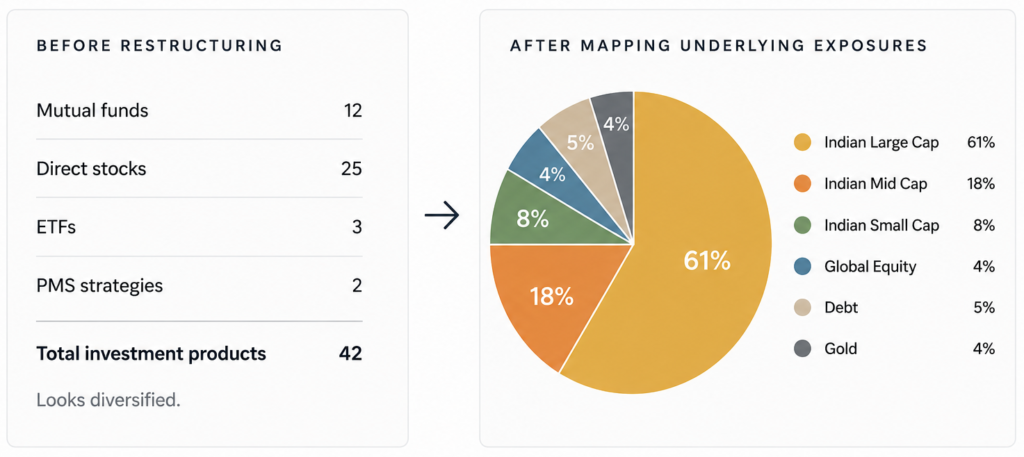
Despite owning 42 different products, 61% of the portfolio is exposed to Indian large caps, resulting in a concentrated portfolio. Only 4% is allocated to global equity, 5% to debt and 4% to gold.
The takeaway is not that Indian equities are too high. It is that the number of products tells us very little about the structure of the portfolio.
A portfolio should be evaluated based on its underlying exposures, not its product count.
This becomes particularly relevant when investors combine multiple mutual funds and ETFs.
Different products can have different names, investment philosophies and fund managers while owning many of the same companies.
The overlap matrix illustrates this clearly.
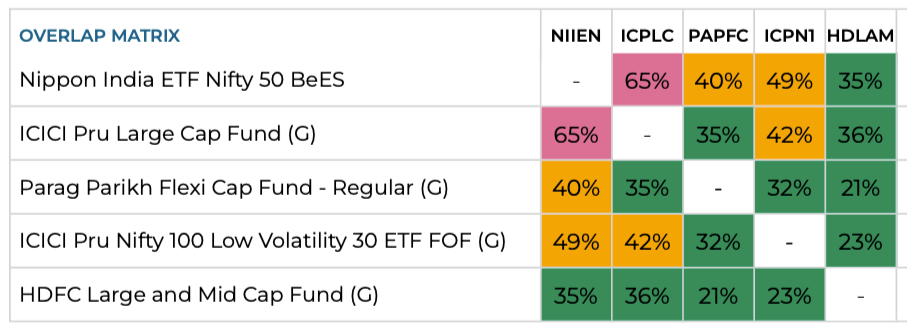
For example, the Nippon India ETF Nifty 50 BeES and ICICI Prudential Large Cap Fund have a 65% overlap in their holdings. The Nifty 50 ETF and ICICI Prudential Nifty 100 Low Volatility 30 ETF have a 49% overlap.
Owning both may still serve a purpose. But two products do not automatically provide two independent exposures.
This is why diversification should be assessed at the portfolio level, rather than at the investment-product level.
True portfolio diversification also requires thinking across asset classes.
Different assets can respond differently to changes in economic conditions, interest rates, inflation and investor sentiment.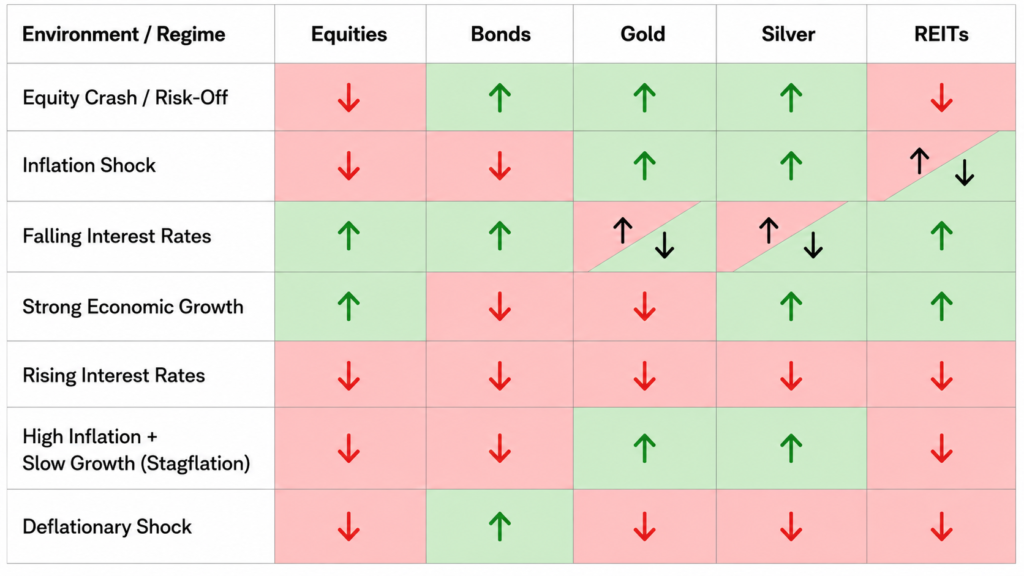
The purpose of owning different asset classes is not that every asset will perform well at the same time. It is precisely the opposite.
Equities may benefit from strong economic growth. Bonds can provide stability and may benefit from falling rates. Gold and silver can play an important role in inflationary or risk-off environments. REITs and InvITs provide exposure to real assets and different cash-flow streams.
The objective is to combine these exposures thoughtfully so that the portfolio is not entirely dependent on one economic outcome.
Asset-class diversification is only one part of the equation.
A portfolio can still be poorly diversified if most of its equity exposure is driven by the same sectors or themes.
Consider a portfolio heavily exposed to banks, NBFCs, autos, real estate and consumer discretionary companies. These are different sectors, but they can all be influenced by similar underlying economic drivers: credit growth, interest rates, employment, consumer confidence and domestic economic activity.
Similarly, IT services, pharma exporters and other globally oriented businesses may belong to different sectors but share exposure to global growth, the US economy and currency movements.
Sector diversification is therefore necessary, but not always sufficient.
Investors should also consider the economic drivers behind their investments.
The more useful question is not simply:
“How many sectors do I own?”
It is:
“How many different economic outcomes can my portfolio withstand?”
That is a much more meaningful definition of diversification.
Once diversification is viewed this way, portfolio construction becomes more deliberate.
A useful framework is to think of the portfolio in three layers:
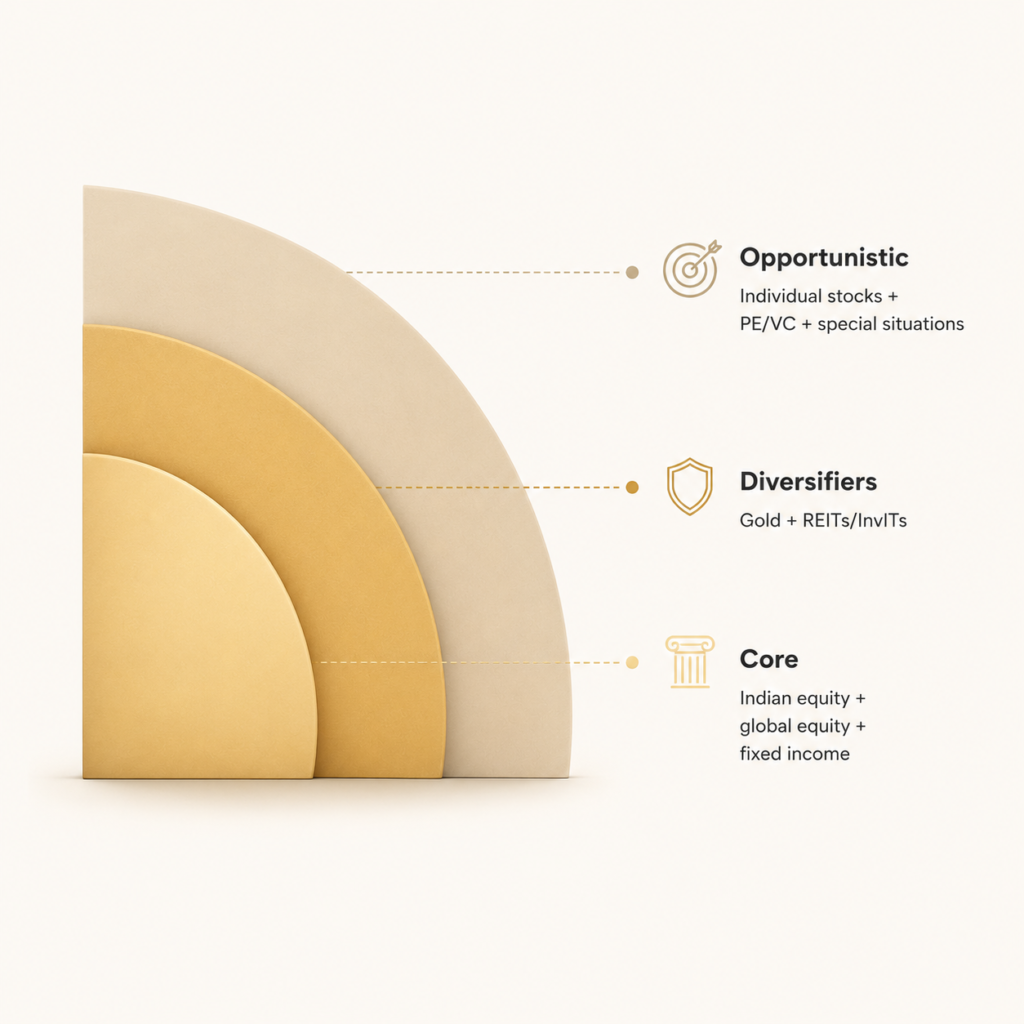
The important point is that every investment has a job.
A portfolio constructed this way may contain fewer investments than an accumulated portfolio, but each allocation has a defined role.

Sri Subhash Yerneni
Sri Subhash is an astute banking and finance professional with 14 years of real-world experience in wealth management, advisory of financial instruments such as mutual funds-equity and debt-alternate investment funds ( AIF)-structure and offshore products-private equity-venture capital/debt-bonds and MLDs-priority banking-cash management-team management-and working with various cultures in various nations.

